
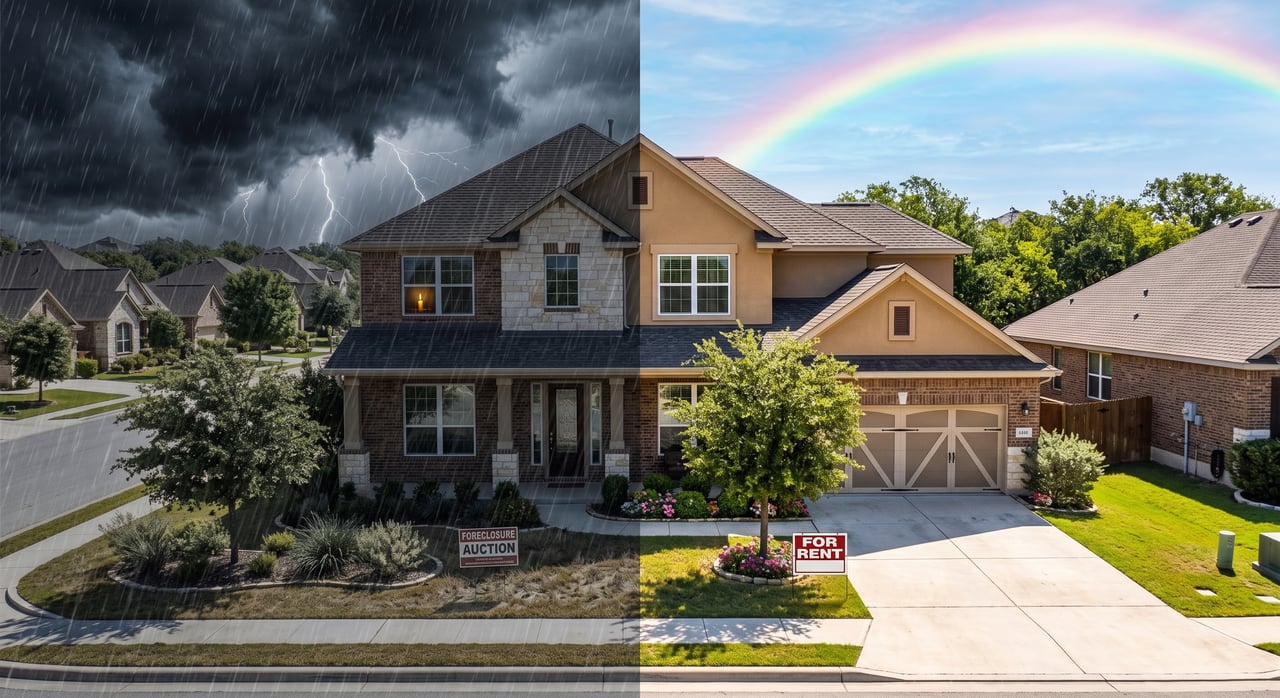
Real estate investing in San Antonio is won or lost on carrying costs, not on the purchase price. A rental here pays property tax on its full appraised value with no homestead break, and that tax bill feeds straight into how a DSCR lender decides whether the property qualifies for a loan.
This guide covers four things every San Antonio investor needs before buying: the real 2025 Bexar County tax math on a rental, how DSCR loans work, the appraisal changes taking effect November 2, 2026, and where distressed and off-market deals come from. No rate quotes. Just the numbers and the rules.
Why Rentals in San Antonio Pay More Property Tax
Texas has no state income tax, and local governments make up for it with property tax. Under Texas Tax Code Section 23.01, property is appraised at its market value as of January 1.
The bigger gap for investors is the homestead exemption. The Texas Comptroller says school districts must give a $140,000 exemption on a residence homestead, which is the owner's principal residence. A rental isn't your homestead, so it gets taxed on the full value.
Here is what that looks like on a hypothetical $350,000 rental inside San Antonio city limits in Northside ISD. The rates are the official 2025 rates from Bexar County's tax rate page. The home value is hypothetical.
Taxing unit | 2025 rate per $100 | Tax on a hypothetical $350,000 rental |
|---|---|---|
Bexar County | 0.276331 | $967.16 |
Road and Flood Control | 0.023668 | $82.84 |
Alamo Community College District | 0.149150 | $522.02 |
University Health | 0.276235 | $966.82 |
San Antonio River Authority | 0.018300 | $64.05 |
City of San Antonio | 0.541590 | $1,895.57 |
Northside ISD | 1.004900 | $3,517.15 |
Combined | 2.290174 | $8,015.61 |
If that same house were your homestead, the $140,000 school exemption alone would take $1,406.86 off the Northside ISD line, before any local-option exemptions. As a rental, you pay all of it. Rates are set every fall, so confirm current figures with the appraisal district for your county before you run an offer.
The Real Cost Stack on a San Antonio Rental
Here is a hypothetical annual stack on the same $350,000 rental. Only the tax line uses published rates. Every other number is a hypothetical placeholder so you can see the math. Swap in real quotes for the home you're considering.
Line item (annual) | Amount | Source |
|---|---|---|
Rent collected ($2,300 a month) | $27,600 | Hypothetical |
Property tax | $8,015.61 | 2025 Bexar County rates, hypothetical value |
Insurance | $2,400 | Hypothetical |
HOA dues | $600 | Hypothetical |
Vacancy (one month empty) | $2,300 | Hypothetical |
Repairs and maintenance | $2,800 | Hypothetical |
Property management | $2,200 | Hypothetical (fees are negotiable) |
Costs before financing | $18,315.61 | |
Left to cover financing | $9,284.39 a year ($773.70 a month) |
That last line is the whole game. Whatever is left after carrying costs has to cover the loan. Two layers can shrink it fast: a municipal utility district tax or a public improvement district assessment, both common in newer subdivisions. See MUD taxes explained for how to find those rates before you sign.
DSCR Loans Explained for San Antonio Investors
A DSCR loan qualifies you mainly on the property, not on your W-2 or tax returns. DSCR stands for debt service coverage ratio. The lender compares the property's rent to its full monthly cost.
How the ratio works
Divide the monthly rent by the property's full monthly housing cost: the loan payment (principal and interest), property taxes, insurance, and any HOA dues. The result is the ratio.
- Ratio of 1.00: the rent exactly covers the monthly cost.
- Ratio above 1.00: the rent covers the cost with room to spare. A 1.25 means rent is 25% more than the monthly cost.
- Ratio below 1.00: the rent doesn't cover the cost. Some programs allow it, many don't.
Each lender sets its own minimum ratio, and the terms change with it.
Why San Antonio's tax bill matters so much
Property tax sits inside that monthly cost. In the example above, the tax alone runs $667.97 a month ($8,015.61 divided by 12). Two identical homes renting for the same amount can land on opposite sides of a lender's minimum ratio just because one sits in a MUD or a higher-rate school district. Check the taxing units on an address before you fall in love with the rent.
Where the rent number comes from
Depending on the program, a lender may use the appraiser's estimate of market rent, an existing lease, or the lower of the two. Ask which. That makes the appraisal central to a DSCR loan, and it's why the appraisal changes below matter to investors.
What else to know before you apply
- Business-purpose rules: Credit to buy a rental you don't live in is generally treated as business-purpose credit, which is exempt from Regulation Z under 12 CFR 1026.3(a). That means fewer of the consumer-loan protections you may be used to. Read every term.
- Prepayment terms: Some DSCR programs charge a fee if you pay off or refinance early. Ask before you sign, especially if you plan to sell or refinance soon.
- Vesting: Many investors buy in an LLC. Ask the lender whether the program allows it, and ask an attorney and CPA whether it makes sense for you.
- Reserves and credit: Programs still look at credit and cash reserves. Requirements vary by lender.
- Short-term rentals: Whether a lender counts short-term rental income, and how, varies by program.
The New Appraisal Rules Starting November 2, 2026
Fannie Mae and Freddie Mac have redesigned the residential appraisal report. The new standard is called UAD 3.6, with a redesigned Uniform Residential Appraisal Report (URAR). Per the UAD 3.6 FAQ, it is mandatory for all new appraisal reports submitted on or after November 2, 2026. It has been available voluntarily since January 26, 2026.
What changes for investors
- Market rent moves into the main appraisal. The FAQ says estimating monthly market rent will be part of the appraisal assignment, in a new Rental Information section of the URAR. In most cases the separate rent schedule (Form 1007) won't be completed on its own anymore.
- The Operating Income Statement is gone. The GSEs have retired Form 216, which was used to show income on small multifamily properties.
What that means for your deal
- The appraiser's rent opinion carries more weight. On a DSCR loan, if the appraiser's market rent comes in below your projection, your ratio drops, and so can the loan amount or the terms.
- Give the appraiser good rent evidence. Through your lender, provide signed leases and comparable rentals nearby. Better data going in means fewer surprises coming out.
- 2-4 unit buyers should ask how income will be documented now that Form 216 is retired.
- Ask which report your lender will order. DSCR lenders aren't required to follow Fannie and Freddie forms, but many use the same appraisal formats. Know before you're in contract.
Finding Distressed and Off-Market Deals in San Antonio
Some of the strongest numbers in San Antonio investing come from properties that never hit the open market. Owners facing foreclosure, inherited homes, and tired landlords can all be motivated sellers. Much of the starting information is public record.
- Foreclosure notices: In Texas, most foreclosure sales happen at public auction between 10 a.m. and 4 p.m. on the first Tuesday of the month. Notice must be posted and filed with the county clerk at least 21 days before the sale, under Texas Property Code Section 51.002. Bexar County publishes these foreclosure notices as open data. The County Clerk's October 2026 list shows 530 postings: 520 mortgage foreclosures and 10 tax foreclosures.
- Ownership records: The Bexar Appraisal District and the Bexar County Clerk's real property records show who owns a property and what's recorded against it.
Public records only get you an address and a name. The hard part is reaching the right owner quickly and respectfully. For investor clients, I combine public records with professional title and property-data tools to pull owner information on distressed properties fast, so we can move before a property gets crowded with offers.
One rule I hold to: many of these owners are going through something hard. A fair offer and straight talk are the only way I approach them.
From the Field
I'm personally seeing investors with strong foresight get liquid so they can move on foreclosures. A lot of 2023 buyers stretched to get into their homes, and since then rising insurance premiums and higher tax bills have pushed their escrow payments up. Many new construction buyers also weren't ready for the jump when their first tax bill was based on the unimproved lot and the next one on the finished home. Whether this turns into a wave or not, the investors who are liquid and ready to move fast will get there before the next savvy investor catches on.
Four Ways to Invest in San Antonio Real Estate
1. Long-term rental
Buy a single-family home or small multifamily property and lease it for a year or more. Texas landlords carry real duties. Under Chapter 92 of the Texas Property Code, a landlord must make a diligent effort to repair conditions that materially affect a tenant's health or safety once properly notified. The same chapter governs security deposits. Have a real estate attorney review your lease.
2. House hack with a VA loan
For veterans and service members stationed at Joint Base San Antonio, this is the overlooked play. VA.gov says a VA purchase loan can buy a home of up to 4 units, and you have to live in the home you buy. Live in one unit and rent the others. Plan move-out timing with your lender before your next PCS.
3. Short-term rental
Inside city limits, every short-term rental needs a permit. The City of San Antonio splits them into Type 1 (the owner's or operator's primary residence) and Type 2 (not occupied by the owner or operator). Operators must register for hotel occupancy tax and report monthly, even in months with no bookings.
4. New construction rental
New homes come with lower early maintenance and builder warranties, and builders often offer incentives. How you structure an incentive changes the appraisal, your tax evidence and your cash to close. Builder incentives in San Antonio walks through all three structures. Browse current new construction homes across Greater San Antonio to see what's available now.
Tax Moves Every San Antonio Investor Should Make
- Watch your appraisal notice. BCAD's 2026 notice announcement described continued softening in the residential market. If your value looks high, you can protest it with the appraisal district.
- Don't assume a homestead exemption. It applies only to your principal residence.
- Talk to a CPA about depreciation, deductions and what happens when you sell, before you buy.
Planning your exit? Selling a house in San Antonio breaks down what it costs to sell.
FAQ
Is San Antonio a good place to invest in real estate?
It depends on the numbers for the specific property. Texas has no state income tax, but property taxes are high and rentals get no homestead exemption. Run the full cost stack, including any MUD or PID, before you decide.
What is a DSCR loan?
A DSCR loan qualifies you mainly on the property's rent compared with its full monthly cost, instead of on your personal income. Each lender sets its own minimum ratio and terms.
How does the new appraisal form affect investors?
Starting November 2, 2026, the appraiser's market rent estimate is part of the main appraisal report under UAD 3.6. On a DSCR loan, that rent number can decide whether the property qualifies, so give your appraiser strong rent evidence through your lender.
Can I use a VA loan to buy an investment property?
Not a pure investment property. VA loans require you to live in the home, but you can buy up to 4 units, live in one and rent the others.
Run Your Numbers With a Human
As a San Antonio and Hill Country Realtor who also originates loans, I can look at the deal and the financing together. I'll pull the taxing units on the address, check for MUD and PID layers, track down owner information on distressed properties, and price DSCR, conventional or VA financing against the same rent.
Online calculators can't see the tax districts on a specific address, what an appraiser will say the rent is, or today's loan pricing for your situation. If you want to start investing anywhere in Greater San Antonio, send me what you're looking for and I'll run a free numbers audit. Rate and payment questions are exactly why to call.
Call or text (210) 510-9337 | Request a free numbers review
Gary Goetz | Texas REALTOR®, Empact Realty powered by eXp Realty, License #829889 | Vice President, Direct Rate, NMLS #2839423 | Direct Rate Company NMLS #2320473 | Equal Housing Opportunity. This article is general information, not a commitment to lend or an offer of credit. Loan programs, terms, and eligibility are subject to credit approval and change without notice. Tax figures are estimates; verify with the appropriate appraisal district.